
No products in the cart.
%42 Discount


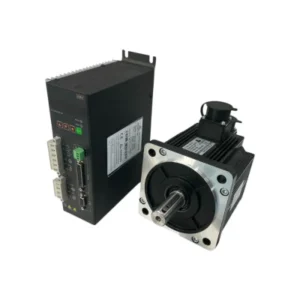
7.5kW Servo Motor Set 180ST-M48015 380V T3A-H75F-RANF
Original price was: 3,057.30$.1,770.02$Current price is: 1,770.02$.
7.5 kW Servo Motor Set 180ST-M48015 T3A-H75F-RANF – High Power and Industrial Precision. Offered with the assurance of Mermak CNC Technology Market, the 7.5 kW Servo Motor Set 180ST-M48015 T3A-H75F-RANF is designed for CNC and industrial automation applications requiring high power.
In stock
🔥 Special for Today Only %42 Discount Opportunity!📦 Category: AC Servo Motors🏷️ Power: 7.5 kW🏷️ Operating Voltage: 380 V AC🏷️ Flange Size: 180 mm🏷️ Brake Configuration: Standard🏷️ Maximum Speed: 1500 RPM
Mermak assuranceFrom factory to end user · importer / main dealer · strong stock
ImporterMain dealer / distributorStrong stockGood priceCorporate invoice
In stock / available to order · 14-day return for standard unused products; conditions may vary for custom size/cut products.
7.5KW Servo Motor Set 180ST-M48015 380V T3a-H75F-RANF
INDUSTRIAL AUTOMATION PARTS | SUPERIOR PERFORMANCE SERIES
Detailed Product Review
The 7.5KW Servo Motor Set 180ST-M48015 380V T3a-H75F-RANF is an integrated system designed for industrial motion control applications with high inertia and under heavy loads. This set consists of the 180ST-M48015 model AC synchronous servo motor with a continuous power output of 7.5 kW (7500 Watts) and the T3A-H75F-RANF model servo drive, which optimizes the motor’s dynamic performance. The basic operating principle of the system is to provide closed-loop feedback control via a high-resolution incremental encoder that continuously monitors the position and speed of the motor shaft. The drive receives target position or speed commands from the controller and precisely modulates the current and voltage applied to the motor’s stator windings. The difference between the target and actual values (error), received from the encoder’s real-time feedback, is processed instantaneously by the drive’s PID (Proportional-Integral-Derivative) control algorithms, minimizing the error by adjusting the motor’s torque output. This closed-loop structure ensures high-precision positioning, repeatability, and stable speed control, even under load variations, friction, or external forces, thereby increasing the system’s dynamic response and rigidity.
The 180ST-M48015 servo motor is manufactured with high-quality magnetic materials, low-loss stator laminations, and a precisely machined rotor structure, designed for durability and long life in industrial environments. The motor’s 180 mm flange size indicates its high torque capacity and mechanical robustness. The T3A-H75F-RANF drive is equipped with advanced power electronics components (e.g., IGBTs with high switching frequencies) and digital signal processors (DSP). This architecture enables high current control, fast response times, and various protection functions (overcurrent, overvoltage, overtemperature, etc.). For system integration, the T3A-H75F-RANF drive is directly compatible with industrial CNC controllers (Mach3, LinuxCNC, Siemens, Fanuc, etc.) via Pulse+Direction, CW/CCW (Clockwise/Counter-Clockwise), and Quadrature signal inputs. This set offers a reliable and precise motion control solution, especially for applications requiring synchronized and vibration-free movement on the X, Y, and heavy Z axes of large CNC routers and milling machines, high-inertia gantry systems, heavy transport and positioning tasks in automated production lines, as well as processes in sheet metal and metal processing machines requiring high cutting forces and stable speed control.
Advantages of the 7.5KW Servo Motor Set 180ST-M48015 380V T3a-H75F-RANF
High Power and Torque Density: The 7.5 kW (7500 Watt) continuous power output allows the 180ST-M48015 servo motor to produce high and stable torque even under heavy industrial loads. This power capacity is critical for rapid acceleration of large masses, overcoming high cutting forces, and maintaining nominal speed under continuous operating conditions. High torque density refers to the motor’s ability to perform more mechanical work relative to its physical size, thus achieving high performance in a more compact structure. It enables the creation of stable motion profiles without speed drops, especially in large gantry systems or heavy axes, even with sudden load changes.
Closed-Loop Precise Position and Speed Control: The integrated high-resolution incremental encoder precisely detects the angular position and speed of the motor shaft in milliseconds, providing feedback to the T3A-H75F-RANF servo drive. This closed-loop control mechanism allows the drive to continuously correct the deviation between the target and actual values. As a result, positioning accuracy in very small fractions of a millimeter, zero step loss, smooth speed profiles unaffected by load variations, and high repeatability are achieved. This feature is crucial for enhancing system performance and product quality in applications requiring precise machining, synchronized movements, and complex trajectory tracking.
Mermak, with 16 years of experience, operates from its factory and warehouse in Ankara Uzay Sanayi. We ensure that website stock quantities and prices are up-to-date. Stocked products are dispatched directly from our warehouse, eliminating production waiting times. We provide careful packaging, meticulous invoice and document handling, and collaborate with reliable logistics partners. The Mermak team closely monitors the shipment process. Upon request, product videos and factory tours can be arranged via WhatsApp or our contact channels. We proudly supply to numerous countries including the United Kingdom, United States, Canada, Australia, Ireland, and New Zealand, alongside similar international markets.
| Power | 7.5 kW |
|---|---|
| Operating Voltage | 380 V AC |
| Flange Size | 180 mm |
| Brake Configuration | Standard |
| Maximum Speed | 1500 RPM |
| Torque | 48 Nm |
| Encoder Resolution | Incremental 2500 PPR |
You must be logged in to post a review.
Taksit Tablosu
Related Products
 %42 Discount5.5kW Servo Motor Set 180ST-M35015 380V T3A-H50F-RANFOriginal price was: 2,842.40$.1,645.61$Current price is: 1,645.61$.View
 %42 Discount5.5 kW Braked Servo Motor Set 180ST-M35015Z1 380V T3A-H50F-RANFOriginal price was: 3,199.37$.1,852.26$Current price is: 1,852.26$.View
 %40 Discount1 kW Servo Motor Set 80ST-M04025 T3A-L20F-RABFOriginal price was: 637.15$.383.63$Current price is: 383.63$.View
Reviews
There are no reviews yet.