




























































Torque Drop in Stepper Motors: Why Power Decreases with Increasing Speed
📑 Содержание (открыть)
Introduction and Technical Analysis
Stepper motors, indispensable components in industrial automation systems, are frequently preferred in applications requiring precise positioning and speed control. Their open-loop control capabilities, simple structure, and cost-effectiveness make them widely used in a range of applications, from 3D printers to CNC machines, robotic systems to packaging lines. However, a critical characteristic in stepper motor performance is torque drop as speed increases. This phenomenon is a fundamental physical reality that can create significant challenges for automation engineers and field technicians during project design and implementation, directly impacting system performance. This detailed field guide and technical article will deeply examine the underlying physical principles, engineering approaches, and practical solutions within the industrial automation sector for torque loss in stepper motors with increasing speed. Our aim is to illuminate this complex topic from an expert perspective, helping readers design and optimize their systems more efficiently and reliably.
Operating Principle and Technical Data
Stepper motors are a type of brushless DC motor that converts electrical pulses into mechanical angular displacements. Magnetic fields, which cause the rotor to rotate by a specific angle (step angle), are generated by sequential current pulses applied to the motor windings. This step-by-step movement allows for high-precision, open-loop (without feedback) control of the motor’s position. Fundamentally, the inductive nature of motor windings is one of the primary causes of torque drop. Each winding acts like a coil, and one of the most important characteristics of coils is their opposition to the rate of change of current flowing through them. This opposition is known as inductive reactance and increases proportionally with frequency (i.e., motor speed). The voltage applied to the motor windings is used to raise the current to a certain level, which enables the motor to produce torque. At low speeds, the current in the windings has sufficient time to reach its full value at each step. However, as motor speed increases, the commutation frequency of the windings rises. At this high frequency, inductive reactance prevents the current from increasing rapidly, and the next step is initiated before the current can reach its full value in the windings. Consequently, the average winding current and thus the generated magnetic field weaken, leading to a reduction in the motor’s ability to produce dynamic torque.
Another critical reason for torque drop is Back Electromotive Force (BEMF). When a motor rotates, the moving magnetic field of the rotor induces a voltage in the stator windings that opposes the direction of the applied voltage from the motor driver, thereby reducing the net voltage. As motor speed increases, the magnitude of the BEMF also increases. Since BEMF reduces the effective voltage applied to the motor windings, by Ohm’s Law, it also reduces the current flowing through the windings. This decrease in current directly affects the torque the motor can produce, causing a significant reduction in torque as speed increases. These two main factors (inductance and BEMF) shape the characteristic torque-speed curve of stepper motors and lead to a dramatic drop in torque at high speeds.
Additionally, iron losses (hysteresis and eddy currents) also increase at high speeds. These losses, caused by the continuous change in the magnetic field within the rotor and stator cores, consume energy and generate heat, which reduces the motor’s overall efficiency and its torque production capacity. Mechanical losses such as friction and wind resistance also increase with speed, but they are generally not as dominant as inductive and BEMF effects.
To ensure optimal performance of stepper motors, especially in high-speed applications, proper motor and driver selection is vital. High-voltage drivers can partially compensate for inductive effects by helping the current rise faster, but the BEMF effect will always persist. Microstepping techniques, while providing smoother motion and lower resonance, can also affect the torque-speed curve by increasing the effective step frequency.
| Parameter | Value/Description |
|---|---|
| Holding Torque | The maximum torque a motor can apply to maintain the rotor’s position when energized and not rotating. Indicates low-speed performance. |
| Dynamic Torque | The torque a motor can continuously produce at a specific speed. Decreases as speed increases. |
| Step Angle | The angular distance the rotor rotates for each electrical pulse. Typically values like 1.8° or 0.9°. |
| Winding Inductance | The resistance of motor windings to current change. High inductance increases torque drop at high speeds. Unit is Henry (H) or milliHenry (mH). |
| Rated Current | The maximum current that motor windings can continuously withstand. Directly related to the motor’s torque capacity. Unit is Ampere (A). |
| Back EMF Constant | The back electromotive force produced by the motor per unit of rotational speed. Also known as Kv or Ke. Unit is V/(rad/s) or V/krpm. |
| Maximum Speed | The highest speed the motor can reach while maintaining an acceptable torque level. Usually specified with a torque-speed curve in datasheets. Must be checked against manufacturer datasheet values. |
| Rotor Inertia | The resistance of the motor rotor to rotational motion. High inertia increases acceleration and deceleration times. Unit is kg·m². |
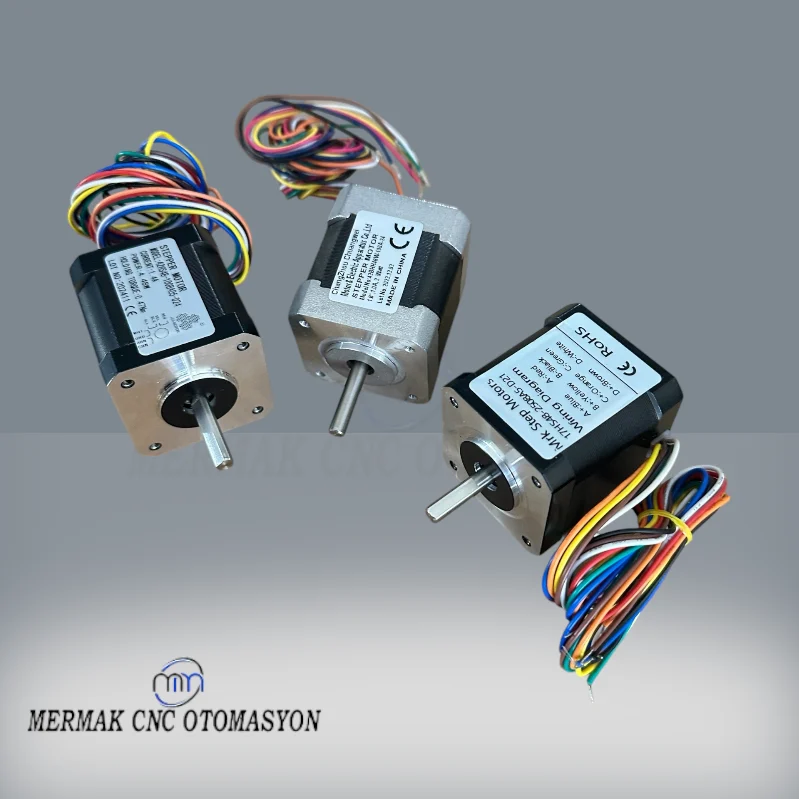
Field Considerations
- Motor and Load Matching: When selecting a stepper motor, focus not only on holding torque but also on the dynamic torque requirement at the maximum speed needed for the application. The motor’s torque-speed curve should be carefully compared with the load’s inertia and friction forces. The ratio of load inertia to motor inertia is typically aimed to be between 1:1 and 10:1; however, higher ratios can increase torque loss and resonance issues. Selecting an excessively large motor increases cost and size, while a motor with insufficient torque capacity can lead to missed steps.
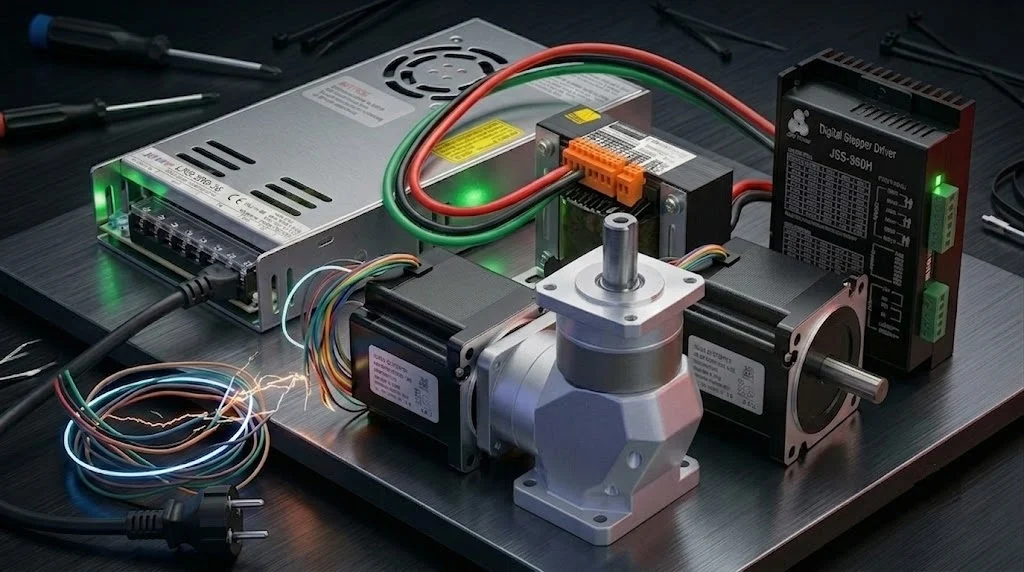
- Driver Selection and Supply Voltage: The voltage capacity of the stepper motor driver directly affects high-speed performance. A higher supply voltage allows the current in the motor windings to rise faster, somewhat reducing the effect of BEMF and enabling more torque at higher speeds. However, the rated voltage values of the driver and motor must not be exceeded. Current-controlled drivers (chopper drivers) are critical for maintaining a constant current through the motor windings, ensuring the motor produces optimal torque across its entire speed range.
- Microstepping and Resonance Management: Using microstepping allows the motor to move more smoothly and reduces low-speed resonance effects. However, as the number of microsteps increases, the motor’s effective step frequency also increases, which can make inductive reactance and BEMF effects more pronounced, accelerating torque drop, especially at high speeds. Therefore, a balanced choice must be made between the number of microsteps and the speed and torque requirements. To avoid resonance regions, the motor’s natural frequencies should be well understood, and the resonance damping features in the driver should be effectively utilized.
- Thermal Management and Cooling: As speed increases, losses (copper and iron losses) in the motor windings and core generate heat. Excessive heating can degrade the motor’s magnetic properties, reducing its torque capacity and shortening insulation life. Therefore, especially in applications requiring continuous high speed or high torque, active cooling (fans, heat sinks) or motors with higher thermal classes may be necessary. The motor’s operating temperature should be kept within the manufacturer’s specified limits.
- Cable Length and Quality: The length and cross-section of the cable between the motor and driver affect signal integrity and power transmission. Long cables can add inductance and capacitance, leading to signal distortion and power losses. This becomes more pronounced with high-frequency signals. Using low-resistance, well-shielded cables and keeping cable lengths to a minimum is important to prevent performance losses.
- System Rigidity and Mounting: The rigidity of the mechanical system optimizes motor performance by minimizing vibrations and resonances. Loose connections, flexible couplings, or a weak chassis structure can disrupt the precise movement of the stepper motor and cause missed steps. Ensure the motor is mounted on a solid base and chassis.
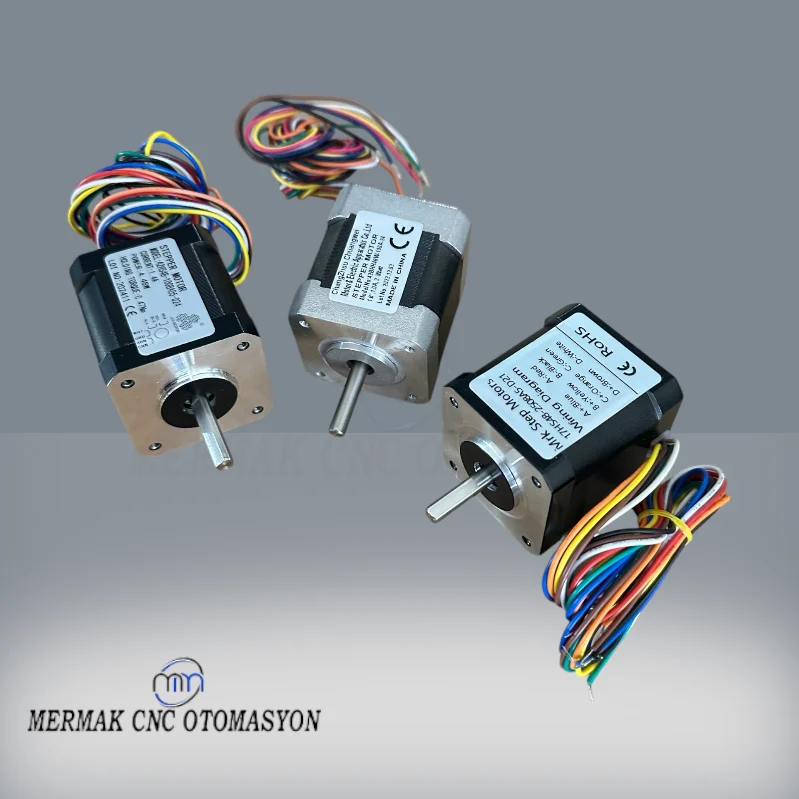
Common Problems and Solutions
Torque drop in stepper motors as speed increases can lead to various fault scenarios in the field. One of the most common problems is the motor missing steps at speeds lower than expected. This usually results from insufficient dynamic torque to overcome the load’s inertia or friction. As a solution, the motor’s torque-speed curve should be re-examined, and if necessary, a higher torque motor or a driver with a higher supply voltage should be selected. Additionally, acceleration and deceleration ramps should be carefully adjusted, as overly steep ramps can prevent the motor from meeting instantaneous torque demands. Another issue is excessive vibration and noise occurring at high speeds. This typically results from the motor operating near its resonance frequencies or inadequate microstepping implementation. Solutions include increasing the number of microsteps, using drivers with resonance damping features, or shifting the motor’s operating speed away from resonance regions. Motor overheating is also a frequent problem, usually caused by incorrect adjustment of the motor’s rated current or duty cycle, insufficient cooling, or continuous operation at high torque. Thermal management should be improved, driver current settings checked, and if necessary, a motor with higher thermal capacity or active cooling solutions should be implemented. Finally, the situation where the motor runs slower than expected or fails to reach its specified maximum speed is generally due to the driver’s insufficient voltage capacity or the motor’s high inductance. Switching to a higher-voltage driver or selecting a motor with lower inductance can resolve this issue. At the root of all these problems lies a misunderstanding of the motor’s torque-speed characteristics and the dynamic requirements of the application. A detailed system analysis and appropriate component selection will largely prevent such problems.
Expert Advice
Torque drop in stepper motors as speed increases is one of the fundamental laws of automation engineering, and understanding this phenomenon is vital for successful system design. Physical principles such as inductive reactance, Back Electromotive Force (BEMF), and increased losses are the primary reasons behind the motor losing power as it speeds up. Our field experience shows that when this characteristic is overlooked, systems encounter numerous problems such as missed steps, overheating, vibration, and overall performance degradation. Therefore, when designing a stepper motor system or optimizing an existing one, it is critical to focus not only on the motor’s holding torque but also on its dynamic torque curve across the entire speed range required by the application. Dynamic parameters such as load inertia, friction forces, and acceleration/deceleration ramps must be meticulously calculated when selecting the motor and driver. High-voltage, current-controlled drivers can significantly improve high-speed performance by minimizing the BEMF effect and enabling the winding current to rise faster. While microstepping techniques are valuable for smooth motion and resonance control, it should be remembered that they can accelerate torque drop at high speeds. Finally, environmental factors such as thermal management, correct cabling, and the rigidity of the mechanical system directly influence stepper motor performance. As expert advice; always select motors and drivers considering the worst-case scenario of the system, carefully examine manufacturers’ detailed torque-speed curves and technical data sheets, and if possible, validate theoretical calculations with prototype tests in the application environment. This proactive approach will both reduce costs and guarantee the long-term reliability and performance of your system. Stepper motor technology, when correctly understood and applied, remains one of the most cost-effective and reliable solutions for many industrial automation applications requiring precise motion control.
FAQ
Why do stepper motors lose torque as their speed increases?
Torque drop in stepper motors occurs primarily due to inductive reactance and Back Electromotive Force (BEMF). As speed increases, inductive reactance impedes the current from reaching its full value in the windings, weakening the magnetic field. Simultaneously, BEMF, which opposes the applied voltage, increases with speed, further reducing the effective current and thus the torque.
What are the practical solutions to minimize torque drop in high-speed stepper motor applications?
To mitigate torque drop, consider using higher voltage drivers to help current rise faster, optimizing microstepping settings, and ensuring proper motor-load matching. Active cooling can manage heat generated at higher speeds, and using low-inductance motors can also improve high-speed performance. Always consult the motor's torque-speed curve.
What are the common problems associated with torque drop and high-speed operation in stepper motors?
Common issues include missed steps, excessive vibration and noise, and overheating. Missed steps often result from insufficient dynamic torque. Vibration and noise can be due to resonance or inadequate microstepping. Overheating typically stems from incorrect current settings, insufficient cooling, or continuous high-torque operation.
What factors should be considered when selecting a stepper motor for high-speed industrial applications?
When selecting a stepper motor, prioritize the dynamic torque required at your application's maximum operating speed, not just the holding torque. Match the motor's torque-speed curve with the load's inertia and friction. Consider the driver's voltage capacity and current control capabilities, as these significantly impact high-speed performance.
How does microstepping affect torque drop at higher speeds?
While microstepping provides smoother motion and reduces low-speed resonance, increasing the microstep count also increases the effective step frequency. This can exacerbate the effects of inductive reactance and BEMF, potentially accelerating torque drop at higher speeds. A balance must be struck between smoothness and high-speed torque requirements.