
No products in the cart.
%35 Discount


DC Spindle Motor 800W ER16 20000RPM + Driver
Original price was: 272.02$.176.81$Current price is: 176.81$.
High-performance DC spindle motor for industrial automation, featuring 800W power and 20,000 RPM speed with an integrated PWM driver and ER16 collet system.
Out of stock
🔥 Special for Today Only %35 Discount Opportunity!📦 Category: GDZ Motors
Mermak assuranceFrom factory to end user · importer / main dealer · strong stock
ImporterMain dealer / distributorStrong stockGood priceCorporate invoice
Contact us for stock information · 14-day return for standard unused products; conditions may vary for custom size/cut products.
DC Spindle Motor 800 Watt ER16 20000RPM + Driver
INDUSTRIAL AUTOMATION PARTS | SUPERIOR PERFORMANCE SERIES
Detailed Product Review
This DC Spindle Motor set is an electromechanical drive unit designed for tasks requiring high speed and precision machining in industrial automation applications. With a nominal power of 800 Watts and a maximum speed of 20,000 RPM, it converts electrical energy into high-speed rotational motion, delivering effective performance in cutting, milling, and engraving operations. The system’s fundamental operating principle relies on the precise modulation of voltage and current applied to the motor windings via the integrated Pulse Width Modulation (PWM) controlled driver, allowing for adjustment of the motor’s angular speed and torque. This control mechanism ensures the motor maintains its desired speed even under load, thereby increasing machining accuracy and optimizing tool life. The ER16 collet system ensures the tool is attached to the spindle axis with high concentricity and rigidity, minimizing vibration and maximizing the quality of the machined surface.
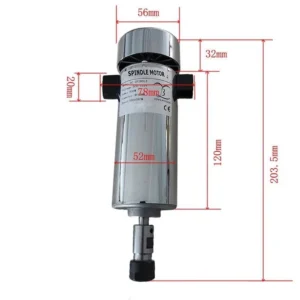
The motor housing is manufactured from aluminum alloys with high thermal conductivity to optimize heat dissipation, and integrated air cooling channels ensure thermal stability even during continuous operation. The rotor and stator components are dynamically balanced for minimal vibration and maximum efficiency at high speeds, supported by long-lasting, low-friction precision bearings. System integration is facilitated mechanically by standard 52mm diameter mounting brackets. Electrical connection and adaptation to automation systems are simplified as the driver unit can be directly powered by 110V or 220V AC mains voltage and can accept PWM or analog speed reference signals from CNC control cards. This motor set is specifically designed to provide high efficiency and repeatability in precision wood, plastic, acrylic, composite, and light metal processing applications, particularly in CNC routers, milling machines, engraving machines, and PCB processing systems.
Advantages of the DC Spindle Motor 800 Watt ER16 20000RPM + Driver
High Speed and Power Capacity: The 800 Watt nominal power and 20,000 RPM maximum speed of this spindle motor offer a critical advantage, especially for fine detail work with small diameter tools, engraving applications requiring high surface quality, and light metal, wood, or plastic milling operations targeting high Material Removal Rates (MRR). High speed reduces the contact time between the tool’s cutting edge and the material, thereby decreasing thermal load and minimizing tool wear while achieving smoother surfaces. This combination allows for the efficient use of small diameter tools, particularly in harder materials, and optimizes machining times, increasing production efficiency.
System Integration with Integrated Driver and Mounting Bracket: The product’s integrated PWM-controlled driver guarantees electrical compatibility between the motor and driver, eliminating the need for external driver selection and configuration. This significantly reduces system commissioning time and minimizes potential electrical incompatibility issues. The driver’s overcurrent, overheat, and short-circuit protection mechanisms enhance the operational safety of both the motor and the driver, preventing unexpected failures. Furthermore, the included standard 52mm diameter mounting bracket allows for quick and precise mechanical installation of the motor onto existing CNC machines or custom machine designs, simplifying the setup process and reducing installation errors.
ER16 Collet Spindle Standard and Tool Flexibility: The ER16 collet spindle, designed according to the DIN 6499 standard, has the capacity to securely clamp a wide range of tool diameters from 1mm to 10mm with high precision. This feature offers users a broad selection of tooling options for different machining operations and makes tool changes fast and efficient. The conical structure and flexible collet segments of the ER collet system ensure the tool is attached to the spindle axis with high concentricity (typically less than 0.01mm runout), increasing machining accuracy and extending tool life. This standard is widely accepted in industrial applications, facilitating the supply of spare parts and tooling, and maximizing operational flexibility and efficiency.
Technical Specifications and Capacity
Feature
Value/Description
Motor Power
800 Watt (Nominal output power)
Maximum Speed
20,000 RPM (Revolutions per minute, adjustable with precise speed control)
Spindle Type
ER16 Collet Spindle (Compliant with DIN 6499 standard, compatible with 1-10mm tool diameters)
Motor Body Diameter
52 mm (Compatible with standard mounting brackets for easy installation)
Cooling Type
Air Cooled (Thermal management via integrated fan and channels)
Driver Control Type
PWM (Pulse Width Modulation) Control (Provides precise and dynamic speed adjustment)
Driver Protection Features
Overcurrent, overheat, short-circuit protections (For system safety and component longevity)
Technical Frequently Asked Questions (FAQ)
What technical principles underlie the speed control of this spindle motor, and what are its effects on machining quality?
The speed control of this DC spindle motor is based on the Pulse Width Modulation (PWM) technique applied by the integrated driver. PWM generates square wave signals with a constant frequency but variable pulse width, effectively altering the average voltage applied to the motor windings. As the pulse width increases, the average voltage applied to the motor windings rises, increasing the motor’s speed; as the pulse width decreases, the speed drops. This method allows for precise adjustment of the motor’s torque and speed characteristics. Precise speed control directly impacts machining quality: a tool rotating at a constant and correct speed applies a more uniform cutting force to the material, reducing surface roughness and enabling finer details. Furthermore, by achieving the optimal cutting speed for a specific material and tool combination, tool life is extended, and material removal efficiency is maximized, which in turn reduces overall production costs.
What are the technical advantages of the ER16 collet spindle system compared to other collet types, and how are tool selection criteria determined?
The ER16 collet spindle system offers technical advantages such as high precision, a wide clamping range, and excellent concentricity due to its compliance with the DIN 6499 standard. Compared to other collet types (e.g., the smaller ER11 or larger ER20), ER16 collets typically cover tool diameters from 1mm to 10mm within a single collet set, providing operational flexibility. Its conical structure and multi-segment design ensure the tool is attached to the spindle axis with high clamping force and minimal runout, which enhances machining accuracy and minimizes surface defects caused by tool vibration. Tool selection criteria are determined by considering the hardness of the material to be machined, the desired surface quality, the material removal rate, and the tool diameter. Since ER16 collets support this wide range of tool diameters, they allow for easy selection and quick changes of appropriate tools for different machining strategies and material types, thus saving time and cost in production processes.
What are the technical effects of the air-cooled design on the thermal management and longevity of this spindle motor?
The air-cooled design plays a critical role in the thermal management of this 800 Watt DC spindle motor. Heat generated in the windings and bearings during motor operation can negatively affect performance and lifespan. The integrated air cooling system, through specially designed channels within the motor housing and a fan mechanism, actively removes heat by passing ambient air through the motor’s interior. This convective heat transfer maintains the motor’s operating temperature at optimal levels, preventing degradation of winding insulation, reduction in bearing lubricant viscosity, and weakening of magnetic properties. Low and stable operating temperatures allow the motor to maintain its efficiency, sustain its torque capacity, and prevent components from experiencing thermal stress, even during prolonged high-speed operations, significantly extending the motor’s overall service life. This reduces maintenance costs and enhances system reliability.
How do the integrated driver’s overcurrent, overheat, and short-circuit protection mechanisms enhance system safety and motor longevity?
The integrated driver’s overcurrent, overheat, and short-circuit protection mechanisms are critical engineering features that directly impact the operational safety and component longevity of the spindle motor system. Overcurrent protection prevents the motor windings from overheating and potentially burning out by cutting off the driver’s current supply when the motor exceeds its nominal current values (e.g., due to tool jamming or overload). Overheat protection automatically shuts down the system when critical temperature thresholds, detected by temperature sensors within the driver or motor, are exceeded; this prevents thermal degradation of semiconductor components and motor insulation materials, ensuring long-term reliability. Short-circuit protection instantly detects undesirable low-resistance connections in the motor terminals or wiring, preventing high current flow and protecting both the driver’s power electronics components and the motor from irreversible damage. This triple protection mechanism enhances system durability and minimizes maintenance costs by preventing unexpected failures.
Mermak has 16 years of experience in the industrial automation sector. Our products are stocked and prepared from our Ankara Uzay Sanayi factory/warehouse. You can find up-to-date stock quantities and prices on our website. Stocked products are dispatched directly from our warehouse, eliminating production waiting times. We ensure careful packaging and meticulous follow-up of invoices and documents. We partner with reliable logistics providers, and the Mermak team monitors the shipment process closely. Upon request, factory tours or product video demonstrations can be arranged via WhatsApp or our contact channels. We proudly supply our products to customers in the United Kingdom, United States, Canada, Australia, Ireland, New Zealand, and South Africa, as well as similar countries and international markets worldwide.
| Collet Standard | ER16 |
|---|
You must be logged in to post a review.
Taksit Tablosu
Related Products
 %39 Discount800W DC Spindle Motor with DriverOriginal price was: 115.80$.70.64$Current price is: 70.64$.View
 %39 DiscountDC Spindle Motor 800W ER16 20000RPM (Motor Only)Original price was: 134.40$.81.98$Current price is: 81.98$.View
 %53 Discount0.75 kW 24000 RPM ER20 Spindle Motor - Premium SeriesOriginal price was: 367.66$.171.00$Current price is: 171.00$.View
Reviews
There are no reviews yet.