


































































Understanding and Preventing Positional Errors in Rack and Pinion Systems

📑 Table of contents (Click to open)
Practical notes for CNC router, automation and industrial motion systems.
What Causes Positional Errors in Rack and Pinion Systems?
Rack and pinion systems are fundamental linear motion components in industrial automation, widely used in applications demanding precision and power. However, issues like positional errors, where the system deviates from its intended location beyond acceptable tolerances, can significantly disrupt operations, especially in high-precision CNC machines, robotic arms, and conveyor systems. These errors impact production quality, efficiency, and even safety. Understanding the root causes, which often stem from a combination of mechanical wear, assembly inaccuracies, environmental factors, and control system deficiencies, is crucial for effective troubleshooting and prevention.
Principle of Operation and Technical Data
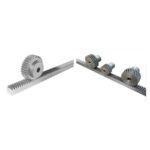
A rack and pinion system converts rotary motion into linear motion. A pinion gear, driven by a servo motor or gearbox, rotates and engages with the teeth of a rack, causing the rack to move linearly. The system’s accuracy relies on precise control of the pinion’s rotation and the resulting linear displacement. Deviations from this ideal operation are the primary source of positional errors, often referred to as cumulative positioning errors.
Key Technical Causes of Positional Errors:
- Backlash: The inherent clearance between the rack and pinion teeth. Excessive backlash, due to manufacturing tolerances or wear, causes a delay in motion transfer when the direction of rotation changes. This directly impacts positioning accuracy, especially during rapid directional changes or high dynamic loads. Systems designed for reduced or zero backlash offer higher precision but come at a higher cost.
- Tooth Wear and Damage: Continuous operation, inadequate lubrication, high loads, or particulate contamination can lead to tooth surface wear and profile degradation. This increases backlash, impairs proper tooth meshing, and negatively affects both motion accuracy and repeatability.
- Mounting Errors: Improper mounting of the rack to its base or the pinion to the motor shaft can introduce axial misalignment, parallelism errors, or excessive stress. A rack not perfectly parallel to its mounting surface can cause uneven loading on the pinion, leading to localized wear and reduced overall system rigidity, thus triggering positional errors.
- Thermal Expansion/Contraction: Temperature fluctuations in industrial environments cause materials to expand or contract. For long racks, this dimensional change can lead to significant positioning errors. Differences in thermal expansion coefficients between coupled components can exacerbate the issue.
- System Rigidity and Vibration: Insufficient rigidity in the machine frame or the rack’s support structure can lead to flexing or vibrations during high-speed movements and accelerations. These deflections can result in transient positional errors not detected by the encoder. Vibrations also accelerate tooth wear and can interfere with encoder readings.
- Encoder and Feedback System Errors: Inaccurate position feedback from the encoder is a common culprit. Insufficient encoder resolution, cabling issues, electrical noise, contamination, or encoder malfunction can lead to incorrect position data being sent to the control system, causing the machine to misposition itself.
- Control System and Algorithm Deficiencies: Incorrect tuning of PID control loops (gain, integral, derivative) in the PLC or CNC controller affects the system’s dynamic response. Aggressive tuning can cause vibrations, while under-tuned settings lead to slow response times and positioning errors. Software features like backlash compensation, if not properly calibrated, may not fully resolve the issue.
- Inadequate Lubrication and Maintenance: Lack of regular and proper lubrication increases friction, accelerates wear, and shortens the system’s lifespan. Metal-to-metal contact due to insufficient lubrication leads to rapid wear and overheating.
| Parameter | Value/Description |
|---|---|
| Backlash | 0.01 – 0.1 mm (application-dependent). Target <0.01 mm for high-precision systems. |
| Tooth Profile Accuracy | DIN 5-10 tolerance. Lower DIN number indicates higher accuracy. |
| Material Hardness | 45-60 HRC (Hardened steel) for wear resistance. |
| Mounting Tolerance (Parallelism) | 0.02 – 0.05 mm/meter, depending on rack length. |
| Thermal Expansion Coefficient | Approx. 11-13 µm/m°C for steel. Critical for long racks. |
| Encoder Resolution | 1000 – 100,000 pulses/revolution (PPR) or higher, based on minimum required step movement. |
| System Rigidity | Maximum allowable deflection under load (e.g., <0.05 mm). |
| Lubrication Frequency | Daily, weekly, or monthly, based on manufacturer recommendations and operating conditions. |
Field Considerations for Prevention
- Periodic Maintenance and Lubrication: Crucial for system longevity and accuracy. Regularly inspect teeth for wear, apply the recommended lubricant type and quantity. Ensure lubrication points are clean.
- Mounting Precision and Alignment: Ensure the rack is mounted perfectly parallel, straight, and rigid. Adjust the pinion-to-rack mesh with the correct backlash – not too tight, not too loose. Use laser alignment tools for precise setup.
- Environmental Control: Monitor and control ambient temperature, humidity, dust, and contamination. Use protective bellows or enclosures where necessary to shield components from harsh environments.
- Encoder and Feedback System Integrity: Verify encoder connections, check for electrical noise, and ensure the encoder resolution meets application requirements. Clean and calibrate encoders periodically. Optimize control system feedback loops (PID tuning).
- Load and Dynamic Impact Management: Ensure operating loads, speeds, and accelerations remain within the design limits of the rack and pinion. Employ soft start/stop ramps and consider shock absorbers to mitigate dynamic stresses.

Common Issues and Solutions
- Excessive Backlash:
- Issue: Noticeable delay or position error upon direction change; palpable looseness between teeth.
- Solution: Adjust backlash using adjustable pinion mechanisms if available. Replace worn rack or pinion. Consider zero-backlash or pre-loaded pinions for high-precision needs. Enable and calibrate software backlash compensation.
- Tooth Wear or Damage:
- Issue: Polished, pitted, or broken teeth surfaces; increased noise or vibration during operation.
- Solution: Replace worn or damaged components. Verify lubrication system effectiveness and lubricant type. Implement protective bellows or seals to reduce contamination. Re-evaluate load conditions if excessive stress is indicated.
- Faulty Encoder Readings or Malfunction:
- Issue: Inconsistent position feedback; sudden jumps in speed/position values; system hunting around the target.
- Solution: Inspect encoder cable connections and connectors. Shield cables or add filters to mitigate electrical noise. Clean the encoder, especially optical types. Test and replace faulty encoders. Ensure encoder resolution is adequate.
- Mounting and Alignment Errors:
- Issue: Rack not seated properly, parallelism errors, uneven pinion loading, localized wear, high friction.
- Solution: Re-check and correct rack parallelism and pinion alignment using precision tools. Ensure mounting surfaces are clean and flat. Verify correct torque on mounting bolts. Reinforce support structures for increased rigidity.
- Thermal Deformation:
- Issue: Inconsistent positioning with temperature changes, especially over long travel distances.
- Solution: Maintain a stable operating temperature. Utilize thermal compensation features in the control system if available, calibrated with temperature sensor data. Review material choices for components with significantly different thermal expansion rates.
- Control System Tuning Problems:
- Issue: Slow response, overshoot/undershoot, hunting, or unstable positioning.
- Solution: Optimize PID control loop parameters (Proportional, Integral, Derivative) via auto-tuning or manual adjustment. Adjust speed and acceleration ramps to match application dynamics without causing excessive mechanical stress.
Expert Advice for Optimal Performance
Positional errors in rack and pinion systems are complex issues requiring a holistic approach, integrating mechanical, electrical, and software components. Proactive measures, starting from the design phase, are essential. Selecting the correct rack and pinion based on application requirements—precision, speed, load, and environment—is paramount. For high-precision tasks, consider pre-loaded or zero-backlash pinions and more rigid support structures. High-resolution encoders are critical for accurate feedback.
During installation, meticulous attention to alignment and mounting is vital. Using professional tools like laser alignment systems ensures accuracy and minimizes human error. Preventive maintenance, including regular lubrication and inspection for wear, is non-negotiable. Protecting components from environmental contaminants with bellows or seals extends their service life.
Control system optimization is key. Properly tuned PID parameters, along with active use of features like backlash and thermal compensation, enhance dynamic response and positioning accuracy. Continuous monitoring using vibration analysis or thermal imaging can help detect potential issues before they escalate. In industrial automation, precision directly impacts productivity, product quality, and operational reliability. Addressing positional errors in rack and pinion systems with a comprehensive, expert strategy is fundamental to achieving long-term success.
For solutions tailored to your specific industrial CNC needs, request a quote on WhatsApp today.
Related product categories: Genel · Düz Diş Kremayer Dişli Çeşitleri · Helis Diş Kremayer Dişli Çeşitleri