



































































Helical vs. Straight Rack: Understanding the Differences for Industrial Applications

📑 Table of contents (Click to open)
Discover the core distinctions between helical and straight racks, focusing on their tooth profiles and how these affect performance in industrial settings. Understand which type is best suited for your CNC router machine, automation lines, and motion control needs.
Practical notes for CNC router, automation and industrial motion systems.
In industrial automation and motion control, the conversion of rotary motion to linear motion is fundamental. Two key components facilitating this are the helical rack and the straight rack. Both work in conjunction with a pinion gear: as the pinion rotates, it drives the rack linearly, or vice versa. The primary distinction lies in their tooth profiles, which significantly influence their performance characteristics, application suitability, and cost.
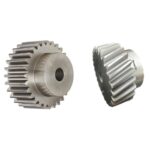
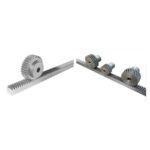
Straight racks feature teeth that run parallel to the rack’s axis. This straightforward design simplifies manufacturing and reduces costs, but can lead to impact loads at the point of contact, resulting in noisier operation. Helical racks, conversely, have teeth angled at a specific helix angle to the rack’s axis. This more complex geometry allows for smoother, more gradual engagement between the pinion and rack teeth, offering several performance advantages.
Operating Principles and Technical Data
Rack and pinion systems are widely employed in CNC machines, robotic arms, automation lines, and linear actuators to achieve high-precision and repeatable movements.
Straight Racks
With their teeth aligned axially and parallel to the rack’s axis, straight racks typically engage with the pinion on a single tooth at a time. When one tooth is fully engaged, the load is concentrated on that single point of contact. This can result in abrupt engagement and disengagement, leading to:
- Higher noise levels
- Potential for increased backlash (play between teeth)
- More noticeable vibrations, especially at lower speeds
However, their simpler manufacturing process makes them a more cost-effective option. A key advantage is that they do not generate axial thrust, which can simplify bearing and mounting designs in certain applications.
Helical Racks
The angled (helical) teeth of a helical rack ensure that multiple teeth are in contact with the pinion simultaneously. This gradual, continuous engagement distributes the load over a wider surface area, minimizing impact loads and offering significant benefits:
- Higher Load Capacity: With the load spread across multiple teeth, helical racks can transmit higher torques and forces compared to straight racks.
- Smoother and Quieter Operation: The progressive tooth engagement eliminates the abrupt contact found in straight racks, resulting in significantly quieter and vibration-free motion.
- Reduced Backlash: The continuous multi-tooth contact inherently minimizes system backlash, leading to higher positioning accuracy.
- Higher Speed Capability: Smoother operation and reduced vibration allow helical rack systems to operate reliably at higher linear speeds.
The defining characteristic of helical racks is the generation of axial thrust due to the angled teeth. This force must be accounted for in the bearing and mounting system design, adding complexity and potentially increasing overall system cost. Their manufacturing process is also more intricate, contributing to their higher price point. Nevertheless, for applications demanding high performance, precision, and longevity, helical racks are often the preferred choice.
| Parameter | Straight Rack | Helical Rack |
|---|---|---|
| Tooth Profile | Teeth are straight and parallel to the axis. | Teeth are angled in a helix relative to the axis. |
| Tooth Contact | Typically single-tooth contact; load concentrated on one tooth. | Multiple teeth in contact simultaneously; load distributed over a wider area. |
| Operating Noise | Higher noise levels, potential for impact sound. | Quieter operation, smooth tooth transition. |
| Load Capacity | Lower load capacity, more sensitive to sudden load changes. | Higher load capacity, more resistant to impact loads. |
| Positioning Accuracy | Higher potential for backlash, moderate precision. | Lower backlash, high positioning accuracy. |
| Axial Thrust | None. | Present; requires appropriate bearing design. |
| Cost & Manufacturing | Simpler manufacturing, generally lower cost. | More complex manufacturing, generally higher cost. |
| Typical Applications | General automation, less precision-critical tasks, low-to-moderate speeds. | CNC machines, robotics, high-precision positioning, high speeds, heavy loads. |
Field Considerations
- Mounting and Alignment Precision: For both rack types, precise mounting and accurate alignment between the pinion and rack are crucial. Minor misalignment in helical racks can cause vibrations, wear, and inefficiency due to their angled teeth. While straight racks may offer slightly more tolerance, precise alignment is always necessary for optimal performance.
- Backlash Adjustment: Backlash, the play between gear teeth, directly impacts system precision. Although helical racks naturally have less backlash, proper adjustment is vital for system longevity and accuracy in both types. Excessive backlash leads to impact loads and noise, while too little can cause overheating and rapid wear. Backlash is typically adjusted by modifying the pinion’s position relative to the rack.
- Lubrication and Maintenance: Regular and correct lubrication is essential for all gear systems. It reduces friction and wear, extends system life, and enhances efficiency. Select lubricants appropriate for the operating conditions (temperature, load, speed) and perform periodic checks and replenishment. Lubrication is particularly critical for high-speed, high-load helical rack systems.
- Material Selection and Hardness: The material and surface hardness of the rack and pinion should be chosen based on the application’s load, speed, and expected lifespan requirements. Hardened and ground teeth offer higher load capacity and durability. Helical racks, often used in demanding applications, typically require higher quality materials and manufacturing processes.
- Axial Load Management (for Helical Racks): The inherent axial thrust of helical racks must be a key consideration in system design. The pinion’s bearing system must be designed to absorb this thrust and maintain the pinion’s correct position. Failure to do so can lead to premature bearing failure or positional errors.

Common Issues and Solutions
- Noise and Vibration: More common with straight racks, often caused by excessive backlash, misalignment, or insufficient lubrication. Solutions include backlash adjustment, correcting alignment, and ensuring proper lubrication. In helical racks, noise can indicate overload, mounting errors, or tooth damage.
- Wear and Tooth Damage: Insufficient lubrication, overloading, incorrect material selection, or foreign debris can lead to tooth wear or breakage in both types. Regular lubrication checks, adherence to load limits, and keeping the system clean are vital. Tooth wear increases backlash and degrades system performance.
- Increased Backlash: Over time, tooth wear or loose mounting components can increase backlash, reducing positioning accuracy and increasing vibration. Periodic backlash checks and adjustments are necessary, and worn components should be replaced. Increased backlash is often more noticeable in helical racks due to their inherently lower initial backlash.
- Positioning Errors: Backlash, system flexibility, or control system issues can cause positioning errors, especially in high-precision applications. Address mechanical backlash, select components with appropriate stiffness, and optimize control system settings. Helical racks are designed to minimize these errors.
- Overheating: Excessive friction, poor lubrication, or overloading can cause the system to overheat, degrading lubricant properties and accelerating tooth wear. Check lubrication, review load conditions, and consider a more efficient rack and pinion combination if necessary.
Expert Recommendation
Selecting the right rack and pinion system is crucial for industrial automation. Straight racks, with their simpler design, lower cost, and lack of axial thrust, are suitable for general automation tasks like material handling, basic conveyors, or less precision-critical positioning where noise is not a major concern.
Helical racks, despite their higher initial cost due to more complex manufacturing, offer superior performance. Their multi-tooth contact provides smooth, quiet operation, high load capacity, reduced backlash, and excellent positioning accuracy, making them indispensable for demanding applications such as CNC machines, robotic arms, precision laser cutters, high-speed automation lines, and aerospace. The axial thrust generated by helical racks is a manageable design factor with appropriate bearing and mounting solutions.
My expert advice is to clearly define your application’s critical performance parameters: load capacity, required speed, positioning accuracy, noise tolerance, and budget. If your application demands high precision, quiet operation, high speeds, and heavy loads, the long-term benefits of helical racks—reliability, efficiency, and longevity—outweigh their initial cost. For less demanding tasks, straight racks can be an economical and sufficient choice. Ensuring compatibility between the chosen rack type, pinion gear, bearing system, and overall machine structure is key to guaranteeing optimal performance and system lifespan. The right choice impacts not only initial cost but also operational efficiency and maintenance ease.
Ready to optimize your motion control system? Request a quote on WhatsApp today!
Related product categories: Helis Kremayer · Düz Kremayer · Genel