
































































DCRS-02J Digital Mode Switch
Detailed Product Review
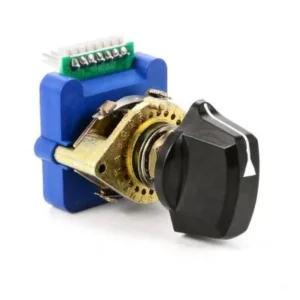
The DCRS-02J Digital Mode Switch is an electromechanical control component for industrial automation systems, particularly in CNC machines and robotic applications, enabling the operator to precisely and reliably select machine operating modes. This switch is designed for transitioning between critical operating modes such as manual, automatic, semi-automatic, and jog. Its operating principle relies on a series of contacts or optical sensors within the internal structure of a mechanical rotary switch, generating a unique digital signal combination corresponding to each position. When the operator turns the switch, a 24-step mechanical detent mechanism provides clear physical feedback at each 15° rotation increment, ensuring the desired mode is accurately selected. The generated digital output signals are transmitted directly to the digital input modules of the CNC control unit or PLC, and are instantly interpreted by the control system to change the machine’s operating status. This digital signal transmission eliminates the risk of noise and deviation seen with analog signals, ensuring high signal integrity and thus error-free mode transitions. This feature is critically important, especially in high-speed and precision manufacturing environments.
The material construction of the DCRS-02J is designed to withstand harsh industrial conditions. The outer casing is made from high-strength engineering plastics or alloy metals resistant to impacts and chemical effects. The internal mechanism consists of wear-resistant metal alloys and high-quality electrical contact materials, offering long life and repeatable precision. In terms of system integration, it is designed for standard panel mounting and can be easily adapted to existing control panels or new designs. Electrical connection is made via terminals conforming to industrial standards, and its electrical parameters are optimized for direct compatibility with the digital input modules of industry-leading CNC control systems such as Fanuc, Mitsubishi, and Siemens. This compatibility simplifies integration engineering processes by providing a standard interface across different control platforms and minimizes commissioning times. The primary application areas for this product include CNC lathes, milling machines, machining centers, and general industrial automation systems. In these systems, it is an indispensable component for the operator to reliably control machine movements, program execution statuses, and safety modes.
Advantages of the DCRS-02J Digital Mode Switch
Precise Multi-Mode Selection and Positioning Accuracy: The DCRS-02J offers a rotary mechanism with 24 distinct positions and a fixed 15° mechanical rotation angle between each position. This structure ensures that the switch is physically locked and clearly perceived by the operator when switching between operating modes such as manual, automatic, semi-automatic, and jog. The mechanical detent mechanism prevents the switch from resting in unintended intermediate positions, minimizing operational errors and potential machine damage that could result from incorrect mode selection. Each 15° step is converted into a unique binary or Gray code signal by an internal digital encoder or contact set. This digital output is transmitted directly to the CNC control unit, guaranteeing that mode changes are processed instantly and without error. This precision maximizes operator control over the machine, especially in high-speed and complex machining operations, ensuring the continuity of production processes.
Superior Environmental Protection (IP65) and Industrial Durability: The DCRS-02J features an IP65 protection rating according to IEC 60529 standard. This classification indicates that the switch is completely protected against dust ingress (first digit ‘6’) and is resistant to low-pressure water jets from any direction (second digit ‘5’). This level of protection ensures the internal mechanism and electrical components of the switch are protected even in harsh industrial environments where chips, metal dust, cooling fluids, oils, and other particles are prevalent. The switch’s casing and sealing elements (e.g., special elastomeric seals and O-rings) are manufactured from materials resistant to long-term chemical exposure and mechanical wear. This structural integrity guarantees that the switch’s electrical performance is not affected by environmental factors, minimizes the risk of short circuits or failures, and thus offers a continuous operational lifespan on the production line. IP65 protection reduces maintenance costs and optimizes the product’s total cost of ownership.
Wide Control System Compatibility and Ease of Integration: The DCRS-02J Digital Mode Switch is designed for full compatibility with leading CNC control systems widely used in the industrial automation sector, such as Fanuc, Mitsubishi, and Siemens. This broad compatibility ensures that the switch’s output signal formats and electrical interface (typically compatible with 24V DC digital inputs) can directly connect with the standard input modules of these systems. The digital codes generated by the switch are easily interpretable by control systems, eliminating the need for any additional signal converters or adapters. This greatly simplifies integration into existing machine fleets, saves engineering time, and reduces installation costs. Furthermore, the standardized interface offers a consistent operational experience even in facilities with different brands of control systems and simplifies spare parts management. This universal compatibility makes the DCRS-02J a flexible and cost-effective solution for various automation projects.
Technical Specifications and Capacity
FeatureValue/Description
Product CodeDCRS-02J
FunctionDigital Mode Selection and Control Switch
Number of Positions24 Steps (Multi-Position)
Mechanical Rotation Angle15° Precision Positioning
Protection ClassIP65 (Complete Protection Against Dust Ingress, Resistant to Low-Pressure Water Jets)
Output TypeDigital Output (Fast and Accurate Signal Transmission)
Compatible SystemsFanuc, Mitsubishi, Siemens, and similar common CNC control systems
Technical Frequently Asked Questions (FAQ)
With what electrical parameters and protocols are the DCRS-02J’s digital output signals integrated into CNC control systems?
The DCRS-02J Digital Mode Switch is designed to operate with a 24V DC supply voltage according to industrial standards and produces digital output signals at this voltage level. The output type can typically be configured as NPN or PNP transistor outputs, allowing the switch to be directly compatible with the logic levels and current requirements of the digital input modules of various CNC control systems (e.g., Fanuc, Mitsubishi, Siemens). The signal protocol is defined as a unique binary code or Gray code sequence corresponding to each mode position. These codes are connected in parallel to the digital input ports of the control unit, and each mode selection is represented by the activation or deactivation of a specific bit combination. This direct digital interface maximizes signal integrity, increases resistance to electromagnetic interference, and minimizes signal delay, ensuring fast and reliable mode transitions. During integration, appropriate cabling and protection measures should be taken, considering the input impedance of the control system and the output current capacity of the switch.
How does the switch’s 15° mechanical rotation angle ensure precision in mode selection and prevent incorrect selection?
The fixed 15° mechanical rotation angle of the DCRS-02J is provided by a high-precision detent mechanism within the switch’s internal structure. This mechanism ensures that the switch is physically locked in each mode position, providing a distinct “click” feel. This physical feedback assures the operator that the desired mode has been precisely selected. Furthermore, this fixed angular separation prevents the switch from resting in intermediate positions or unintentionally shifting to another mode due to external factors like vibration. Each detent position triggers a specific configuration of internal contacts or optical sensors to close or open, guaranteeing that the digital signal sent to the control system only changes when a complete and correct mode has been selected. This engineering approach minimizes the margin for operator error and enhances production safety and efficiency by ensuring the machine always remains in a defined operating mode. This mechanical precision directly supports the accuracy of the digital output.
How does the IP65 protection class technically contribute to the durability of the DCRS-02J in industrial environments?
The IP65 protection class forms the basis of the DCRS-02J’s durability in industrial environments. The first digit, ‘6’, indicates that the switch is completely protected against dust ingress; this prevents micron-sized metal chips, wood dust, or other particles from penetrating the switch’s internal mechanism and electrical contacts. This prevents failures such as short circuits, contact wear, or mechanical jamming. The second digit, ‘5’, signifies that the switch is resistant to low-pressure water jets from any direction. This feature prevents cooling fluids, cutting oils, or water used during cleaning from entering the switch. This protection is achieved through specially designed sealing elements (e.g., EPDM or NBR rubber seals, O-rings) and precisely machined casing joints. These technical features ensure that the switch’s electrical performance is not affected by environmental factors, minimize the risk of oxidation and corrosion, and thus provide a long-lasting, reliable, and maintenance-free operational life. This is a critical advantage, especially in production environments with aggressive chemicals or high humidity.
What are the critical engineering considerations during the installation and electrical connection of the DCRS-02J?
Several critical engineering considerations must be addressed during the installation and electrical connection of the DCRS-02J. For installation, the fact that the switch is designed for standard panel mounting requires that panel cutout dimensions and mounting depth precisely match the values specified in the technical drawings. Incorrect installation can compromise the integrity of the IP65 protection class or reduce mechanical stability. For electrical connection, it is essential that the switch’s supply voltage of 24V DC is provided from a stable source with the correct polarity. Connecting the digital output signals to the appropriate digital input ports of the CNC control unit or PLC with correct pin assignments is critical. Incorrect connections can lead to erroneous mode detection in the control system or component damage. Furthermore, to minimize electromagnetic interference (EMI) effects in industrial environments, it is recommended to use shielded cables and keep cable routes separate from power cables. Proper grounding connections are vital for both safety and signal integrity. Finally, performing continuity and insulation tests on all connections before commissioning ensures the system operates reliably and without errors.
Mermak has 16 years of experience in the industrial automation sector. Our products are stocked and prepared from our Ankara Uzay Sanayi factory/warehouse. Website stock quantities and prices are up-to-date. Stocked products are dispatched directly from the warehouse without production waiting. We ensure careful packaging, meticulous invoice and document follow-up, and utilize reliable logistics partners. The Mermak team actively monitors the shipment process. Product videos and factory tours are available upon request via WhatsApp or our contact channels. We supply to numerous countries including the United Kingdom, United States, Canada, Australia, Ireland, New Zealand, and South Africa, as well as similar countries and international markets.