
No products in the cart.
%25 Discount


40×80 Sigma Profile 8 Channel Heavy Duty
Original price was: 56.92$.42.92$Current price is: 42.92$.
High-strength structural element for industrial automation and machine construction. Features 8 integrated T-slots for modular system integration.
In stock
🔥 Special for Today Only %25 Discount Opportunity!📦 Category: 40 mm Aluminum Profiles🏷️ Slot Size: 8 Slots🏷️ Profile Size: 40x80
Mermak assuranceFrom factory to end user · importer / main dealer · strong stock
ImporterMain dealer / distributorStrong stockGood priceCorporate invoice
In stock / available to order · 14-day return for standard unused products; conditions may vary for custom size/cut products.
40×80 Sigma Profile 8 Channel Heavy Duty
INDUSTRIAL AUTOMATION PARTS | SUPERIOR PERFORMANCE SERIES
Detailed Product Review
The 40×80 Sigma Profile 8 Channel Heavy Duty is designed to function as a high-strength structural element in industrial automation and machine construction applications. This profile is used as a fundamental component for load-bearing frames, structures, or linear motion systems, especially in systems subjected to high static and dynamic loads. Its cross-section geometry has external dimensions of 40 mm x 80 mm and features a total of eight integrated T-slot channels, two on each 40 mm and 80 mm surface. These T-slots allow for quick and precise positioning of various fasteners, nuts, and accessories, enhancing the flexibility and reconfigurability of modular systems. The ‘heavy duty’ classification of the profile indicates thicker wall thicknesses and an optimized internal geometry compared to standard sigma profiles. This structural optimization significantly increases its resistance to bending and torsional moments, thus providing reliable performance in more demanding industrial applications requiring higher load-bearing capacity.
This profile is manufactured using the extrusion method from EN AW-6063 T6 aluminum alloy. EN AW-6063 is known for its high strength-to-weight ratio, good corrosion resistance, and excellent machinability. The T6 heat treatment maximizes the alloy’s yield and tensile strength, enhancing the profile’s structural integrity and load-bearing capacity. The profile’s surface is treated with an anodized (anodization) coating. This process creates a controlled oxide layer on the aluminum surface, increasing the profile’s resistance to wear, scratches, and chemical effects. Furthermore, the anodized coating protects the profile against long-term exposure to the elements while maintaining its aesthetic appearance. Precise extrusion and cutting tolerances ensure perfect compatibility with fasteners, improving the vibration damping capability of assembled structures and minimizing geometric deviations during assembly. These features enable the profile to be used with high accuracy and longevity in industrial automation systems, robotic cells, machine chassis, and precision assembly stations.
Advantages of 40×80 Sigma Profile 8 Channel Heavy Duty
High Mechanical Strength and Load-Bearing Capacity: The heavy-duty cross-section geometry significantly increases the profile’s moments of inertia (Ix and Iy) and, consequently, its resistance to bending and torsion. This structural optimization ensures the profile functions as a reliable load-bearing element in applications subjected to high static and dynamic loads, such as heavy conveyor systems, large robotic cells, or high-speed CNC machine chassis, without deformation or structural fatigue. The optimized mechanical properties of the EN AW-6063 T6 alloy through heat treatment enhance the profile’s yield and tensile strength, contributing to the maintenance of safety factors in critical engineering applications.
Superior Surface Protection and Environmental Resistance: The anodized coating applied to the profile’s surface thickens and hardens the aluminum’s natural oxide layer, increasing the profile’s resistance to environmental factors. This coating protects the profile’s surface against scratches, abrasion, UV radiation, and many chemical substances. Especially in industrial environments with humidity, dust, or mild chemical vapors, it prevents corrosion, extending the profile’s service life and minimizing maintenance requirements. The homogeneous structure of the anodized layer also supports long-term aesthetic integrity.
Modular System Integration and Assembly Flexibility: The 8 integrated T-slot channels maximize the profile’s versatile connection and accessory integration capabilities. These channels allow for quick and precise positioning of a wide range of connection and mounting components, such as standard T-nuts, spring T-nuts, corner brackets, hinges, door locks, and panel holders. This modular structure enables engineers and technicians to accelerate prototyping processes, easily make revisions to existing systems, or create new configurations. The flexibility of connection points allows the system to easily adapt to future expansion or reconfiguration needs, thereby optimizing project timelines and costs.
Technical Specifications and Capacity
Feature | Value/Description
Profile Dimensions | 40 mm x 80 mm
Channel Type and Quantity | T-Slot, 8 Pieces (2 channels on each 40mm surface, 2 channels on each 80mm surface)
Weight per Meter (Approx.) | 3.193 Kg/Meter
Material | EN AW-6063 T6 Aluminum Alloy
Surface Treatment | Anodized Coating
Moment of Inertia (Ix) | Approx. 29.1 cm⁴ (Bending resistance around X-axis)
Moment of Inertia (Iy) | Approx. 108.5 cm⁴ (Bending resistance around Y-axis)
Technical Frequently Asked Questions (FAQ)
How do the mechanical properties of EN AW-6063 T6 aluminum alloy affect the structural performance of the profile?
EN AW-6063 T6 aluminum alloy is a medium-strength alloy developed specifically for extruded profiles. The ‘T6’ temper refers to the condition of maximum strength achieved through solution heat treatment and artificial aging. This heat treatment optimizes the alloy’s grain structure and promotes the precipitation of magnesium silicide (Mg2Si) within the aluminum matrix, significantly increasing its yield strength and tensile strength. Typically, the yield strength for EN AW-6063 T6 is around 215 MPa, and the tensile strength is around 250 MPa. These high strength values ensure that the 40×80 Sigma Profile can function in heavy-duty constructions under high static and dynamic loads without permanent deformation. At the same time, the alloy’s relatively low density (approx. 2.7 g/cm³) allows for lighter structures compared to steel profiles while maintaining adequate stiffness and strength. This combination of properties provides advantages in terms of energy efficiency and performance, especially in moving systems or weight-critical applications.
In what engineering parameters does the ‘heavy duty’ classification of the 40×80 Sigma Profile differ from standard sigma profiles, and how do these differences affect the design process?
The ‘heavy duty’ classification of the 40×80 Sigma Profile indicates that the material distribution and wall thicknesses within the profile’s cross-section are optimized compared to standard profiles. This optimization leads to a significant increase in the moments of inertia (moment of inertia) and section moduli (section modulus), which directly affect resistance to bending moments and torsional moments. For instance, the Ix (approx. 29.1 cm⁴) and Iy (approx. 108.5 cm⁴) values specified for this profile are higher than those of standard 40×80 profiles. Higher moments of inertia mean that under the same load, the profile will experience less
| Dimensions | |
|---|---|
| Slot Size | 8 Slots |
| Profile Size | 40x80 |
You must be logged in to post a review.
Taksit Tablosu
Related Products
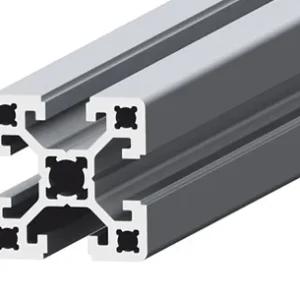 %38 Discount40x40 Sigma Profile 10 Channel Heavy DutyOriginal price was: 30.30$.18.68$Current price is: 18.68$.View
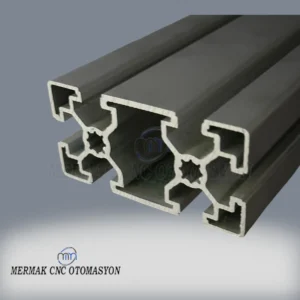 %38 Discount40x80 Sigma Profile | 10 Channel | Lightweight TypeOriginal price was: 37.25$.22.97$Current price is: 22.97$.View
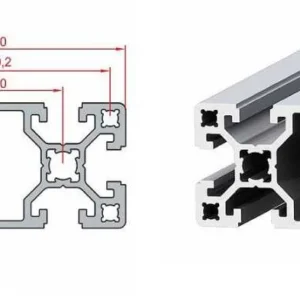 %38 Discount40x80 Sigma Profile 10 Channel Heavy DutyOriginal price was: 50.68$.31.25$Current price is: 31.25$.View
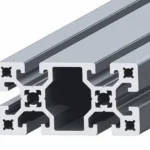
Reviews
There are no reviews yet.