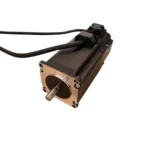


































































Braked Stepper Motor Nema23 2.2 Nm
Detailed Product Review
This Braked Stepper Motor Nema23 is a two-phase, hybrid stepper motor unit with a nominal holding torque of 2.2 Nm. Stepper motors operate on electromagnetic principles that allow the rotor to rotate in specific, discrete angles, providing high-precision positioning capabilities even in open-loop control systems. Sequential pulse trains applied to the motor’s stator windings cause the magnetic field to rotate, advancing the rotor by a specific step angle with each pulse. The integrated brake mechanism is a power-off type electromagnetic brake system that engages when the motor is de-energized or needs to be held in a specific position. This brake mechanically locks the motor shaft, preventing the load from sliding down due to gravity in vertical axis applications, thus preventing unwanted movements and enhancing system safety. The brake typically engages via a spring mechanism and requires electrical current to be applied to the coil to release, offering a fail-safe design.
The motor’s material composition includes laminated steel stator cores with high magnetic permeability, a permanent magnet rotor, and copper windings. The rotor is optimized for low inertia and high torque response. Bearings are selected to industrial standards for long life and low-friction operation. The integrated brake mechanism usually comprises friction pads and an electromagnetic coil; energizing this coil releases the pads. For system integration, this stepper motor works in conjunction with a stepper motor driver and a controller (PLC, microcontroller, or CNC control board). The driver converts pulse signals from the controller into appropriate current sequences for the motor windings, while separate control or an integrated mechanism via the driver is required for brake control. This motor is suitable for various industrial automation applications where secure load holding is critical, including Z-axis applications in CNC machines, holding specific positions for robotic arms, automated storage and retrieval systems, medical devices, and precise optical positioning systems.
Advantages of the Braked Stepper Motor Nema23 2.2 Nm
High Precision Positioning and Repeatability: With a basic step angle of 1.8 degrees, this Nema23 stepper motor offers high-resolution angular movements. Using microstepping techniques with a stepper motor driver, this basic step angle can be divided into fractions like 1/2, 1/4, 1/8, 1/16, or higher, allowing the rotor to move in smaller increments and significantly increasing positioning accuracy. This feature is crucial for tasks requiring sub-millimeter precision, especially in applications like CNC machining, 3D printing, and optical alignment. The open-loop control structure reduces system complexity and cost by eliminating the need for feedback sensors, while its accurate stepping capability ensures high repeatability.
Integrated Load Holding and Enhanced Safety Mechanism: The motor’s integrated brake system is designed to prevent uncontrolled movement of the load, particularly in vertical axis applications or during power outages. This “power-off brake” feature automatically engages when the motor is de-energized or commanded to brake by the driver, mechanically locking the shaft. This prevents the workpiece or tool from falling unintentionally, enhances operator safety, and minimizes the risk of equipment damage. The brake’s holding torque is comparable to the motor’s nominal holding torque, effectively preventing back-driving caused by external loads when the motor is stationary, thus maximizing system stability and reliability.
High Torque Density and Simple Control Integration: This Nema23 frame-sized motor delivers significant power in a compact package with a high holding torque of 2.2 Nm. This high torque density allows it to move and hold heavy loads even with its smaller physical dimensions, offering space efficiency in machine design. The control of stepper motors is generally simpler than other motor types, typically performed via pulse and direction signals, and does not require complex feedback loops. This simplicity speeds up the system integration process and simplifies control software development. Furthermore, the integrated brake reduces assembly time and wiring complexity compared to external braking solutions, contributing to a more organized and reliable overall system.
Technical Specifications and Capacity
Feature<th style="padding: 15px; color: #0a3b7
Alan açıklamalarıDeğerler nereden bulunur?
Kullanım alanı
Neden girilir? Aynı güç, tork veya hız değeri CNC, konveyör, fan, pompa, pano veya genel otomasyon uygulamasında farklı emniyet payı ve farklı ürün sınıfı gerektirir.
Nereden bakılır? Makinenin gerçek kullanım amacından seçilir. Birden fazla kullanım varsa en ağır ve en sürekli çalışan senaryo esas alınır.
Sonuçta neyi etkiler? Sonuç yorumunda risk seviyesi, ürün sınıfı, emniyet payı ve destek notlarını yönlendirir.
Kontrol: Değer pozitif ve gerçek saha/katalog bilgisiyle uyumlu olmalıdır. Varsayılan cnc_router yalnızca örnek başlangıç değeridir.
Hedef devirde kullanılabilir step motor torku Nm
Neden girilir? Dönen sistemdeki mekanik momenttir. Güç, redüktör, fren, pinyon veya mil seçimini doğrudan etkiler.
Nereden bakılır? Motor kataloğundan, torkmetreden, sürücü izleme ekranından veya yük hesabından alınır.
Sonuçta neyi etkiler? kW hesabı, fren torku, kaplin, redüktör ve mekanik dayanım seçimlerinde kullanılır.
Kontrol: Beklenen giriş aralığı: en az 0.001 Nm. Varsayılan 6 Nm yalnızca örnek başlangıç değeridir.
Motorun hedef çalışma devri rpm
Neden girilir? Dönen takım, motor, spindle, kasnak veya fan hızını belirler. Kesme, tork, güç ve çevresel hız sonuçlarını doğrudan değiştirir.
Nereden bakılır? Spindle/inverter ekranı, motor etiketi, kontrol yazılımı, takometre veya üretici katalog değerinden alınır.
Sonuçta neyi etkiler? Kesme hızı, talaş yükü, tork, güç, rulman ömrü ve maksimum hız yorumlarında kullanılır.
Kontrol: Beklenen giriş aralığı: en az 1 rpm. Varsayılan 600 rpm yalnızca örnek başlangıç değeridir.
Emniyet payı %
Neden girilir? Gerçek sahada oluşacak sürtünme, yaşlanma, darbe, sıcaklık ve ölçüm hataları için ek paydır.
Nereden bakılır? Uygulama riskine göre belirlenir. Sürekli, ağır, dikey veya duruşu kritik sistemlerde artırılır.
Sonuçta neyi etkiler? Önerilen motor, güç kaynağı, kablo, vakum, kompresör veya pano kapasitesini güvenli tarafa taşır.
Kontrol: Beklenen giriş aralığı: en az 0 %. Varsayılan 40 % yalnızca örnek başlangıç değeridir.
Çalışma zorluğu
Neden girilir? Bu alan hesap sonucunu doğrudan etkileyen temel girdilerden biridir. Değer yanlış girilirse çıkan kapasite, hız, kuvvet veya maliyet yorumu da yanlış olur.
Nereden bakılır? Değer; ürün etiketi, katalog, kontrol yazılımı, sürücü/inverter ekranı, ölçüm cihazı, teknik çizim veya gerçek saha ölçümünden alınmalıdır.
Sonuçta neyi etkiler? Sonuç kartındaki ana değer, risk seviyesi, ürün sınıfı ve teknik öneri bu girdiye göre şekillenir.
Kontrol: Değer pozitif ve gerçek saha/katalog bilgisiyle uyumlu olmalıdır. Varsayılan normal yalnızca örnek başlangıç değeridir.
Bakım ve mekanik durum
Neden girilir? Akım değeri kablo, sigorta, güç kaynağı, pano ısısı ve cihaz güvenliği için temel veridir.
Nereden bakılır? Pens ampermetre, cihaz etiketi, sürücü/inverter ekranı veya katalog nominal akımından alınır.
Sonuçta neyi etkiler? Kablo, sigorta, gerilim düşümü, güç ve pano ısı yükü hesaplarında kullanılır.
Kontrol: Değer pozitif ve gerçek saha/katalog bilgisiyle uyumlu olmalıdır. Varsayılan normal yalnızca örnek başlangıç değeridir.
Pano / ortam sıcaklığı °C
Neden girilir? Bu alan hesap sonucunu doğrudan etkileyen temel girdilerden biridir. Değer yanlış girilirse çıkan kapasite, hız, kuvvet veya maliyet yorumu da yanlış olur.
Nereden bakılır? Değer; ürün etiketi, katalog, kontrol yazılımı, sürücü/inverter ekranı, ölçüm cihazı, teknik çizim veya gerçek saha ölçümünden alınmalıdır.
Sonuçta neyi etkiler? Sonuç kartındaki ana değer, risk seviyesi, ürün sınıfı ve teknik öneri bu girdiye göre şekillenir.
Kontrol: Beklenen giriş aralığı: en az -20 °C, en fazla 80 °C. Varsayılan 35 °C yalnızca örnek başlangıç değeridir.
Eş zamanlı yük oranı %
Neden girilir? Oran değeri kayıp, emniyet, eş zamanlı çalışma, verim veya fireyi hesaba katmak için kullanılır.
Nereden bakılır? Saha tecrübesi, üretici verisi, ölçülen fire/kayıp oranı veya kullanım senaryosundan alınır.
Sonuçta neyi etkiler? Gerçekçi kapasite, maliyet, risk ve ürün sınıfı önerisinde kullanılır.
Kontrol: Beklenen giriş aralığı: en az 1 %, en fazla 100 %. Varsayılan 70 % yalnızca örnek başlangıç değeridir.