







































































Can Aluminum Profiles and Steel Profiles Be Used Together?

📑 Table of contents (Click to open)
Yes, aluminum and steel profiles can be used together in industrial applications with proper engineering and precautions. This combination leverages the unique advantages of each material, particularly in industrial automation and machine construction. However, critical technical aspects like galvanic corrosion, thermal expansion differences, and mechanical strength variations must be carefully managed.
Practical notes for CNC router, automation and industrial motion systems.
Combining Aluminum and Steel Profiles: A Practical Guide
In industrial automation, machine frameworks, conveyor systems, and custom production lines, the selection of structural components is paramount. Factors such as strength, weight, corrosion resistance, cost, and ease of processing all play a role. Aluminum and steel are two fundamental engineering materials that can complement each other in these aspects. Therefore, using aluminum and steel profiles together in the same structure is a valid and often advantageous approach to achieve specific design goals. This practice, however, requires a thorough understanding of material science and engineering principles. For instance, steel might be preferred for main load-bearing columns requiring high strength, while aluminum profiles can be used for lighter, modular upper structures or cladding. This combination enhances structural integrity while optimizing overall weight, contributing to energy efficiency and ease of assembly. The key lies in identifying and mitigating potential issues arising from the distinct physical and chemical properties of these two metals through appropriate design and application strategies.
Operational Principles and Technical Data
The combined use of aluminum and steel profiles aims to harness the unique properties of each material. Steel, with its high strength, rigidity, and lower cost, is ideal for main load-bearing structures subjected to heavy loads, especially under dynamic conditions or high stress. Aluminum, on the other hand, excels in applications requiring a high strength-to-weight ratio, excellent corrosion resistance, ease of machining, and modularity, making it suitable for lightweight constructions, protective enclosures, moving parts, and rapid assembly systems. In industrial automation, a machine’s main chassis might be constructed from steel, while lighter elements like sensor mounts, actuators, cable management systems, or operator panels can be designed using aluminum profiles. This approach reduces the overall system weight, enhances assembly flexibility, and simplifies future modifications. However, combining these two metals introduces significant technical differences and potential challenges:
- Galvanic Corrosion: Due to their electrochemical potential difference, aluminum and steel can undergo galvanic corrosion when in direct contact in the presence of an electrolyte (moisture, water, saltwater, etc.). In this scenario, the more active aluminum acts as the anode, corroding over time and compromising structural integrity. This is a critical risk factor in industrial environments, especially those exposed to humidity or chemical vapors.
- Thermal Expansion Differences: Aluminum’s coefficient of thermal expansion is approximately twice that of steel. In environments with temperature fluctuations (e.g., outdoor applications or machines undergoing heating/cooling cycles), this differential expansion and contraction can induce stresses, deformations, and eventual loosening or fatigue of fasteners and connections.
- Mechanical Strength and Hardness Differences: Steel generally possesses higher yield and tensile strength than aluminum. This must be considered during the design of connections and load distribution. To prevent stress concentration at connection points, fasteners and details must be selected according to the strength characteristics of both materials.
- Weldability: Aluminum and steel cannot be directly welded due to their differing melting points and metallurgical properties. Therefore, joining typically relies on mechanical fastening methods (bolts, nuts, rivets) or specialized transition elements.
Considering these technical differences, detailed engineering calculations and careful material selection are crucial for successful integration. The following table compares key technical data for aluminum and steel profiles:
| Parameter | Aluminum (e.g., EN AW-6063 T6) | Steel (e.g., S235JR) |
|---|---|---|
| Density | ~2.7 g/cm³ | ~7.85 g/cm³ |
| Modulus of Elasticity (E) | ~69 GPa | ~210 GPa |
| Coefficient of Thermal Expansion (α) | ~23 x 10⁻⁶ /°C | ~12 x 10⁻⁶ /°C |
| Yield Strength (σy) | ~215 MPa | ~235 MPa |
| Tensile Strength (σu) | ~250 MPa | ~360 MPa |
| Electrochemical Potential (vs. Hydrogen) | ~-1.66 V | ~-0.44 V |
| Thermal Conductivity | ~205 W/mK | ~50 W/mK |
Field Considerations for Combined Use
- Preventing Galvanic Corrosion: This is a primary concern. Insulating materials must be used to prevent direct contact between the dissimilar metals.
- Insulating Washers and Gaskets: Plastic (e.g., nylon, PTFE, fiberglass) or rubber washers and gaskets should be placed between fasteners (bolts, nuts) and the profiles to eliminate metal-to-metal contact.
- Insulating Coatings: Protective coatings such as epoxy-based paints, zinc-chromate primers, or galvanizing can be applied to contact surfaces. Anodizing aluminum surfaces also enhances corrosion resistance.
- Appropriate Fastener Selection: Stainless steel (especially grades 304 or 316) bolts and nuts are recommended, but they must still be used with insulating washers. Galvanized steel fasteners can offer some protection.
- Managing Thermal Expansion Differences: Differential expansion can cause significant issues in environments with temperature variations.
- Expansion Joints and Flexible Connections: For larger structures, expansion joints should be incorporated, or flexible fasteners (e.g., elastomeric washers) used.
- Oversized Holes: In bolted connections, oversized or slotted holes on one side can allow for thermal movement, preventing stress buildup.
- Proper Torquing: Bolts should not be overtightened; specified torque values should be followed to allow some flexibility for expansion.
- Mechanical Connection Design and Load Distribution: Connections require careful design due to differing mechanical properties.
- Bolt-Nut Connections: This is the most common and reliable method. Sufficient numbers and appropriate sizes of bolts should be used to ensure proper load distribution. The shear and tensile strengths of the bolts must be suitable for both profiles.
- Riveting: Can be used for lighter loads, but insulation is still necessary.
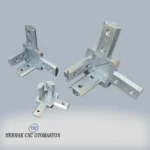
- Special Connectors/Adapters: Custom-designed steel or aluminum adapters can facilitate the joining of different profiles, providing necessary insulation and reinforcement.
- FEM Analysis: For critical applications, Finite Element Analysis (FEM) can be employed to analyze stress distribution and deformation.
By carefully considering these factors and implementing appropriate design and protection measures, aluminum and steel profiles can be effectively combined to create robust, efficient, and durable industrial structures. For expert advice on material selection and structural design for your CNC machinery or automation projects, contact Mermak CNC.
Ready to optimize your industrial projects? Request a quote on WhatsApp today!
Related product categories: Genel · Mekanik · Alüminyum Profiller