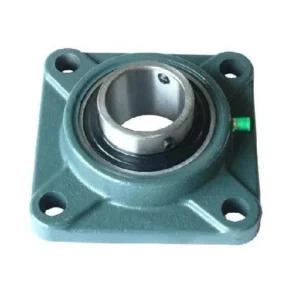
UCF 203 Pillow Block Bearing Unit
Detailed Product Review
The UCF 203 Pillow Block Bearing Unit is a 4-bolt square flange, cast iron housing bearing unit designed for precise and reliable support of rotating shafts in industrial automation systems. Its primary function is to carry radial and limited axial loads in systems with a nominal shaft diameter of 17 mm, allowing the shaft to rotate freely while minimizing friction. This bearing unit consists of a ball bearing whose inner ring is tightly mounted onto the shaft and whose outer ring is seated within the cast housing. The spherical outer ring design allows it to effectively tolerate minor angular misalignment and shaft deflections that may occur during installation or operation. This adaptive feature reduces stress on the bearing and shaft, extending the overall service life of the system and preventing unexpected failures. The integrated grease nipple facilitates periodic lubrication, ensuring the inner components of the bearing are continuously operated under optimal lubrication conditions, which reduces frictional resistance and delays wear.
The housing of the UCF 203 is manufactured from high-quality cast iron. The natural vibration-damping properties and high compressive strength of cast iron allow this bearing unit to provide superior stability, especially in environments with vibration and impact. This material choice minimizes deformation of the rolling elements and rings within the bearing under excessive load, offering long-lasting and reliable performance. The unit’s sealing mechanism prevents dust, chips, moisture, and other environmental contaminants from penetrating the bearing, protecting the internal components and maintaining the effectiveness of the lubricant. This feature makes the UCF 203 an ideal solution for demanding industrial environments such as CNC routers, woodworking machinery, conveyor systems, and automated transport lines. Installation is achieved by rigidly fixing it to a flat surface with four bolts, ensuring high stability and precision in system integration. The shaft is typically secured to the inner ring of the bearing via set screws, offering ease of mounting and dismounting.
UCF 203 Pillow Block Bearing Unit Advantages
Precise Shaft Compatibility (17 mm): The UCF 203 is specifically designed for a nominal shaft diameter of 17 mm, ensuring optimal power transmission and high rotational stability in applications within this shaft size range. The precise fit of the inner ring to the shaft minimizes radial and axial runout during rotation, guaranteeing high accuracy in machine movements. This compatibility ensures uniform distribution of stresses at the bearing points in automation systems requiring precise positioning and repeatability, extending bearing fatigue life and enhancing the overall kinematic accuracy of the system.
Rigid Cast Iron Housing Structure: The housing, made from high-quality cast iron, offers excellent vibration damping capacity and high compressive strength. This structural rigidity ensures the bearing maintains its geometric integrity even under excessive load or impact conditions. The graphite lamellae within the internal structure of the cast iron convert mechanical energy into heat, reducing vibration amplitude and lowering the risk of resonance. This minimizes dynamic loads on the rolling elements within the bearing, significantly extending bearing life and improving the overall operational stability of the machine. Furthermore, the rigid housing helps maintain system accuracy by preventing shaft misalignment over time.
Spherical Outer Ring Design: The spherical outer ring design of the UCF 203 provides the bearing with self-aligning capabilities. This feature effectively compensates for minor angular misalignment errors (typically in the range of ±2 to ±3 degrees) and shaft deflections that may occur during installation or due to structural deformations in the machine chassis. The spherical geometry prevents edge loading and stress concentration on the rolling elements within the bearing, thus preventing premature bearing fatigue. Consequently, the bearing can maintain its nominal load-carrying capacity and offer a longer service life even with non-ideal angular relationships between the shaft and the housing. This design not only simplifies installation but also allows the system to operate more flexibly and durably under dynamic conditions.
Technical Specifications and Capacity
Feature/SpecificationValue/Description
Bearing ModelUCF 203
Shaft Diameter (Nominal)17 mm
Housing Type4-Bolt Square Flange Cast Iron Housing
Housing MaterialHigh-Quality Cast Iron (Provides superior resistance to vibration and impact)
Bearing Outer Ring DesignSpherical (Effectively tolerates minor misalignment and angular deviations in the shaft axis)
Lubrication MechanismIntegrated Grease Nipple (Allows for periodic and effective grease lubrication)
Operating Environment CompatibilitySealed design resistant to dusty, chip-filled, and dirty environments
Technical Frequently Asked Questions (FAQ)
What critical steps should be followed during the installation of the UCF 203 pillow block bearing for optimal performance and longevity?
During the installation of the UCF 203 bearing unit, it is essential to first ensure that the shaft is clean and within the nominal 17 mm tolerance range. The surface roughness and roundness of the shaft are important for the proper seating of the inner ring. When fixing the bearing unit to the machine chassis or mounting surface with four bolts, the torque values of the bolts should be adjusted according to the manufacturer’s specifications. Excessive torque can lead to housing deformation, while insufficient torque can cause the unit to loosen and vibrate. The shaft is typically secured to the inner ring using set screws; tightening these screws diagonally and incrementally ensures the shaft is centered within the bearing and prevents slippage. The flatness and parallelism of the mounting surface are critical for effectively utilizing the alignment tolerance provided by the spherical outer ring. Surface irregularities can cause stress on the housing, shortening the bearing’s life or leading to premature failure. Finally, a manual check should be performed after installation to ensure the bearing rotates freely and shows no abnormal noise or resistance.
How does the spherical outer ring design of the UCF 203 contribute to operational stability and service life in dynamic applications?
The spherical outer ring design grants the UCF 203 self-aligning capabilities, allowing it to dynamically compensate for minor angular misalignments between the shaft and the bearing housing or shaft deflections. In industrial applications, minor shaft axis deviations can occur due to manufacturing tolerances in machine chassis, thermal expansion, or dynamic loads. Standard bearings are sensitive to such deviations, leading to edge loading and stress concentration on the rolling elements, causing premature fatigue and failure. The spherical outer ring of the UCF 203 absorbs these angular misalignments, ensuring a more uniform load distribution among the rolling elements. This reduces friction and heat generation within the bearing, preserves the integrity of the lubricating film, and slows down wear on the bearing components. As a result, the bearing’s dynamic load capacity is utilized more effectively, operational stability is increased, and service life is significantly extended by minimizing unexpected downtime.
Considering typical industrial environments, what is the recommended lubrication schedule and grease type for the UCF 203 with an integrated grease nipple?
The recommended lubrication schedule and grease type for the UCF 203 pillow block bearing unit vary depending on the operating conditions (speed, load, temperature, environmental contamination). For general industrial applications, a lithium soap-based grease with EP (Extreme Pressure) additives, NLGI class 2 or 3, is recommended. This type of grease offers good temperature stability, water resistance, and high load-carrying capacity. In dusty or humid environments, specialized greases providing better sealing and corrosion protection may be preferred. The lubrication schedule should be determined based on the bearing’s operating hours or environmental factors. Lighter loads and lower speeds might allow for longer intervals (e.g., 500-1000 operating hours), while heavy loads, high speeds, or dirty environments may require shorter intervals (e.g., 100-300 operating hours). During re-lubrication via the integrated grease nipple, ensure that old grease is purged and the bearing cavity is completely filled with new grease. Over-lubrication should be avoided as it can cause overheating within the bearing and damage to the sealing elements.
Can the UCF 203 be used in applications with significant axial loads, or is it primarily designed for radial load support? What are its limitations for combined loads?
The UCF 203 is fundamentally a ball bearing unit, primarily designed to carry radial loads. The ball bearing inside effectively distributes and supports radial loads due to the geometry of the rolling elements and raceways. However, it can also accommodate a limited amount of axial load. This axial load capacity is related to the bearing’s internal geometry and the contact angle of the balls. Generally, bearing units like the UCF 203 can handle axial loads up to approximately 10-20% of their radial load capacity without issues. In applications with significant and continuous high axial loads, excessive stress can occur on the bearing balls and raceways, leading to premature fatigue and reduced service life. For combined loads (where both radial and axial loads are present simultaneously), an equivalent dynamic load (P) calculation should be performed and compared with the bearing’s dynamic load capacity (C). Using the formula P = XFr + YFa (where Fr is the radial load, Fa is the axial load, and X and Y are radial and axial factors, respectively), the resulting equivalent load should not exceed the bearing’s nominal dynamic load capacity. Excessive combined loads can lead to damage such as brinelling and spalling on the bearing elements. Therefore, for applications requiring high axial load capacity, specialized bearing types such as angular contact ball bearings or tapered roller bearings should be considered.