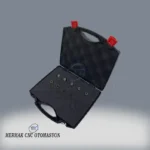



































































ER11 Collet Set with Plastic Case – 7 Pieces
Detailed Product Review
The ER11 collet set is a critical interface component that ensures the precise and secure clamping of cutting tools to the spindle in CNC machining centers. This set forms one of the most important links in the kinematic chain between the tool holder and the cutting tool. Its working principle relies on radial compression, achieved by the collet’s outer conical surface being pressed into the tool holder’s inner conical surface by the collet nut. This clamping force ensures high holding power and axial alignment by encircling the tool shank with the collet’s flexible segments. The ultra-low runout tolerance (±0.0015 mm) minimizes the deviation of the tool from its rotational axis to the micron level, guaranteeing that the cutting edges contact the workpiece at the same point and with equal load on every revolution. This directly impacts the balanced distribution of cutting forces, optimization of material removal performance, and an increase in surface quality and dimensional accuracy, especially in high-speed milling, drilling, and turning operations. Minimum vibration extends tool life while reducing undesirable effects such as thermal deformation and surface roughness on the workpiece.
This ER11 collet set, offered by Mermak CNC, is manufactured from high-quality alloy steel in accordance with industrial standards. This specific material selection ensures that the collets exhibit superior resistance to high clamping forces, repetitive stress cycles, wear, and deformation. The material undergoes a special heat treatment process to achieve an optimal balance of hardness (typically 44-48 HRC) and flexibility, allowing the collets to maintain their precision even with prolonged use. The 7 different collets included in the set (ranging from 1 mm to 7 mm) cover a wide range of tool shank diameters, enabling the secure holding of various cutting tools, from micro drills to small-diameter end mills. The ER standard guarantees universal compatibility of the collets with ER11 collet chucks worldwide, meaning easy integration into existing CNC machine systems. The plastic carrying case protects the collets from environmental factors, allows for organized storage, and ensures easy access for quick tool changes, thereby increasing operational efficiency. These features offer an indispensable solution for modern CNC machines in sectors requiring high accuracy, such as mold making, aerospace, medical device manufacturing, and precision parts manufacturing. Mermak CNC proudly supplies to markets including the United Kingdom, United States, Canada, Australia, Ireland, and New Zealand, alongside similar countries and international markets.
Advantages of the ER11 Collet Set with Plastic Case – 7 Pieces
Ultra-Precise Runout Tolerance (±0.0015 mm): The ±0.0015 mm ultra-low runout tolerance offered by this collet set minimizes the deviation of the cutting tool from its rotational axis. This engineering feature ensures that all cutting edges of the tool contact the workpiece equally and synchronously, preventing overload on any single cutting edge. Consequently, tool life is significantly extended as the risk of localized wear and breakage on cutting edges is reduced. Furthermore, this precision allows for micron-level smoothness on machined surfaces and enhances the dimensional accuracy of the final product, thereby eliminating the need for rework and lowering production costs.
Wide Tool Diameter Coverage (1-7 mm): This 7-piece ER11 collet set covers a broad range of tool shank diameters from 1 mm to 7 mm, offering operators exceptional flexibility for various machining applications. This extensive coverage allows for the secure holding of micro drills, small-diameter milling cutters, engraving tools, and other precision cutting tools with a single collet set. This eliminates the need to invest in multiple collet sets for different tool diameters, simplifies tool inventory management, and shortens operational setup times. The ability to use tools of different diameters with a single set provides high adaptability, especially in environments requiring prototyping, small-batch production, and variable machining requirements.
High-Quality Alloy Steel Material and Heat Treatment: ER11 collets are manufactured from specially selected high-carbon alloy steel and undergo a precise heat treatment process. This combination of material and treatment ensures that the collets maintain their elasticity even when subjected to high clamping forces, exhibiting exceptional resistance to wear, impact, and deformation. The high tensile strength and toughness of the alloy steel guarantee that the collets retain their structural integrity even under prolonged and repetitive stresses. This durability extends the operational life of the collets, reduces maintenance and replacement costs, and supports production continuity by providing consistent and reliable performance in machining processes.
Technical Specifications and Capacity
Specification | Value/Description
Model | ER11 Collet Set
Set Contents | 7 Collets (1mm, 2mm, 3mm, 4mm, 5mm, 6mm, 7mm)
Material | High-Quality Alloy Steel (Heat-Treated, High Resistance to Wear and Deformation)
Holding Capacity | 1 mm – 7 mm Tool Shank Diameters
Precision (Runout Tolerance) | ±0.0015 mm (Maximum Radial Runout, Micron-Level Machining Accuracy)
Collet Type | ER Standard (DIN 6499 / ISO 15488 Compliant, Self-Tightening Mechanism)
Storage and Transport | Durable Plastic Case (Separate Slots for Each Collet, Organized and Protected Storage)
Technical Frequently Asked Questions (FAQ)
What critical advantages does the ±0.0015 mm runout tolerance of the ER11 collet set offer in micro-machining applications, and what factors should be considered to maintain this value?
The ±0.0015 mm ultra-low runout tolerance of the ER11 collet set is critically important in applications such as micro-machining, precision engraving, and fine hole drilling. This low runout minimizes the deviation of the cutting tool from its rotational axis, ensuring that each cutting edge of the tool contacts the workpiece equally and with balanced force. This leads to a homogeneous distribution of cutting forces, preventing excessive stress and thermal loading on any single cutting edge. As a result, the risk of micro-tool breakage is reduced, tool life is extended, and micron-level smoothness and dimensional accuracy are achieved on machined surfaces. To maintain this precision, utmost attention must be paid to the cleanliness of the collets and collet chuck, ensuring the collet nut is tightened to the correct torque during assembly, and protecting the collets from impacts that could cause deformation. Furthermore, ensuring the tool shank fits precisely into the collet diameter and avoiding over-tightening the collet are also important factors in preserving the runout value.
What are the recommended maintenance and cleaning procedures for ER11 collets to ensure their optimal performance and longevity?
Regular and proper maintenance procedures are essential for maintaining the optimal performance and long life of ER11 collets. After each use, the collets, collet chuck, and collet nut should be cleaned of chips, oil, coolant residue, and other foreign matter. Compressed air and a suitable industrial cleaner can be used for this cleaning process. In particular, the inner conical surfaces and segment gaps of the collets must be completely free of particles that could prevent the correct seating of the tool shank. After cleaning, applying a thin layer of anti-rust oil is recommended to prevent corrosion and maintain the collets’ flexibility. Collets should be stored in their designated slots within the plastic carrying case, in a controlled environment away from moisture and dust. Dropping or impacting collets can deform their precise conical structure, compromising runout tolerance, so careful handling is important. Additionally, the tightening torque of the collet nut should be adjusted according to manufacturer specifications; over-tightening can damage the collets, while insufficient tightening can lead to tool slippage.
What engineering principles underlie the conical clamping mechanism of ER11 collets, ensuring tool holding reliability and repeatability, compared to other clamping methods?
The conical clamping mechanism of ER11 collets is based on specific engineering principles that ensure tool holding reliability and high repeatability compared to other clamping methods. This system generates a radial clamping force by pressing the collet’s outer conical surface into the tool holder’s inner conical surface via the collet nut. This pressing force ensures that the collet’s flexible segments grip the tool shank uniformly, 360 degrees, with even pressure. This principle guarantees the axial centering of the tool shank and its secure fixation with high holding power. On the other hand, the collet’s elastic deformation capacity allows for the secure holding of different tool diameters (within the collet’s nominal diameter range). This self-centering and high contact area principle allows the tool to rotate without vibration even at high speeds, which contributes to high machining accuracy by ensuring the tool’s contact point with the workpiece remains constant. Repeatability is achieved by the collet’s ability to maintain the same runout values with each removal and reinsertion, which is a critical factor for process stability in mass production.
What technical compatibility considerations are important during the integration of an ER11 collet set into CNC machines with different spindle interfaces?
When integrating an ER11 collet set into CNC machines with different spindle interfaces, the primary compatibility consideration relates to the selection of the collet chuck. ER11 collets are not directly mounted into the spindle; instead, they are connected to the spindle via an ER11 collet chuck (e.g., BT30-ER11, CAT40-ER11, HSK63A-ER11, etc.). Therefore, the first step in integration is to select a collet chuck that matches the existing CNC machine’s spindle interface type (e.g., BT, CAT, HSK, SK). The collet chuck must have the correct taper and dimensions to ensure a perfect mechanical connection with the spindle, achieving maximum rigidity and minimum runout. Secondly, the balancing class of the collet chuck (e.g., G2.5 @ 25,000 rpm) is important for minimizing vibration at high spindle speeds and extending tool life. Collet chucks with a low balancing class can resonate at high speeds, reducing machining quality and potentially damaging spindle bearings. Finally, the collet chuck’s internal conical surface and collet nut must fully comply with the ER11 standard to ensure proper collet seating and optimal clamping force, which is technically mandatory for ensuring system performance and reliability.